/f/166376/1599x1066/b5c48867bd/digital-device-use.jpg)
Beyond the school day:
the truth about screen time concerns

This article is the second in our new 'Beyond the School Day' insights series - sharing what families told us about the realities they are navigating outside the classroom.
The hours after school can be a balancing act for many Australian families. School is finished, but the working day often is not. Snacks need sorting, bags unpacking, uniforms washed, and the practicalities of getting through the afternoon can leave very little space for anything else.
In our national research, families told us that when afternoons are tight and options are limited, screen time can quickly become the default. Not because parents do not care, but because it is often the easiest “in the moment” solution when time, energy and choices are stretched.
What families told us about screen use after school
The strongest message from parents and caregivers was not a debate about whether screens are “good” or “bad”. It was a concern about how much screen time is happening in the after-school window, and what children may be missing out on as a result.
In this research:
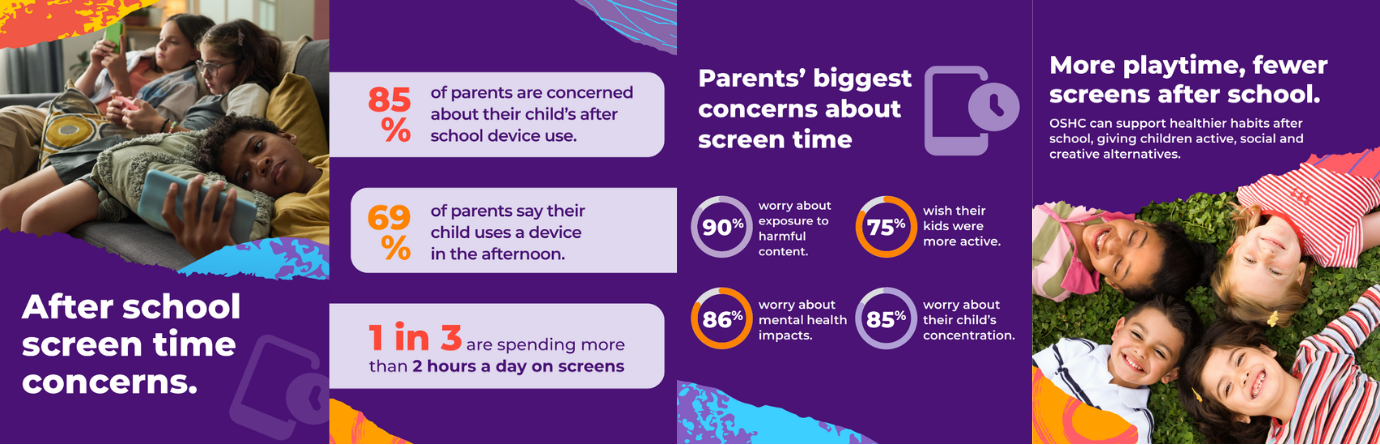
85% of parents said they are concerned about the amount of time their child spends on digital devices after school.
69% of parents reported their child uses a device in the afternoon, described in the summary as the peak time for screen use.
One in three children are spending more than two hours a day on screens.
These findings help explain why screen time has become such a common theme in family conversations. For many, it is not just about what children are watching or playing. It is about what the after school hours have become.
What sits underneath the concern
When parents spoke about screen time, they were often talking about the bigger picture: children’s wellbeing, behaviour, energy levels and how they feel at the end of a long day.
Parents’ biggest concerns included:
exposure to harmful online content
mental health impacts
concentration and attention
This matters because it shows the concern is not abstract. Parents are linking screen time to what they see day to day in their children’s moods, focus and capacity to engage with others.
Families are not just worried. They want alternatives
Alongside concerns, the research also highlights something hopeful: families are clear about what they would prefer children were doing more of after school.
Parents told us they want better alternatives to screen time, with strong preference for:
outdoor activities
reading books
social time with friends
This is an important point. Families are not simply asking for “less screen time”. They are asking for more time for children to play, move, connect and explore, especially in the hours between school finishing and dinner.
Why afternoons are the pressure point
After school is a unique part of the day. Children are often tired. Parents may still be working or commuting. Many households are moving straight into dinner routines and evening responsibilities.
When there are limited after school options, or when families are patching together pick-ups and care arrangements, screens can become the simplest way to keep children occupied and safe.
That does not mean families “choose screens”. It often means screens fill a gap that families did not create.
What supportive after-school care can look like
In the research summary, parents repeatedly pointed towards the value of structured, supervised alternatives that help children spend their afternoons in healthier ways.
When children have access to safe, engaging care outside school hours, afternoons can become a time for:
active play and movement
social connection and friendships
creative activities and learning through play
time to unwind without relying solely on devices
This is not about making every afternoon “productive”. It is about creating space for children to be children after a busy school day.
An important note on families, choice and balance
It is also important to acknowledge that families manage this differently. For some, screens are part of how children relax. For others, screens are a point of conflict or worry. For many, it changes day to day depending on work patterns, energy levels and what support is available.
The key message from families was not a demand for perfection. It was a call for more realistic options so that screens are not the only practical choice in the afternoon.
About the research (Australia)
The JAG Insights research in Australia was conducted by 89 Degrees East, an accredited independent research consultancy. It involved an online survey (February 2025) with more than 1,500 parents or caregivers of children aged 5–12 years across Australia.
Coming next in this series
Next, in the final article in our Beyond the School Day series, we share what families told us about what helps children thrive outside school hours and the kinds of experiences families value most across the school year and holidays.
Related Articles
/f/166376/1380x868/c4d03feab7/juggling-work-and-school-holidays.png)
Beyond the school day: the truth about the after-school juggle
05/03/2026
-Junior Adventures Group
Research shows the after-school juggle is a major pressure point for families. This first insight in our 'Beyond the School Day' series shares what parents are navigating and the support they need.
/f/166376/1380x868/9ca21c8a15/why-play-is-the-brain-s-best-preparation-for-school.png)
Big school, big insights: Why play is the brain’s best preparation for school
17/12/2025
-Junior Adventures Group
Discover how play supports brain development and school readiness. Learn why play-based learning helps children transition confidently into school and OSHC.