/f/166376/1380x868/c266663222/beyond-the-school-day-article-3a.png)
Beyond the school day:
the truth about what families want

This is the final article in our new 'Beyond the School Day' insights series - sharing what families told us about the realities they are navigating outside the classroom.
Families told us they feel childhood has become rushed, stressful and screen‑heavy. And they want after‑school time to feel different.
For many Australian families, what happens after school and during school holidays is not an “extra”. It is a meaningful part of childhood, family life and wellbeing. It is the time when children decompress after a full day of learning, reconnect with friends, move their bodies and enjoy interests that do not fit inside the school timetable.
In our national research with more than 1,500 Australian parents and caregivers, families were clear. They want after-school time that feels safe, social and enriching, not rushed or dominated by screens.
The afternoon mismatch: families want more play, connection and calm
When parents and caregivers talked about after‑school time, they were not describing a desire for “more productivity”. They were describing the basics of childhood wellbeing, the things that help children feel settled and connected.
Families told us they would like children to spend more time on:
Outdoor activities (71%)
Reading books (68%)
Social time with friends (57%)
These preferences paint a clear picture of what families value outside school hours: movement, imagination and connection.
Why this matters beyond the 'busy afternoon'
The hours outside school are often where the tone of the evening is set. When children have a chance to unwind, play and connect, families told us that afternoons can feel more balanced and less pressured.
This matters for children because the after‑school window is when they often need:
time to decompress after concentrating all day
chances to move and play in a way that supports physical health
social connection that builds confidence and belonging
space for creativity, curiosity and independence
Families are not asking for perfect afternoons. They are asking for routines and options that support children to be children, even when life is busy.
The role of care outside school hours
Many families told us that care outside school hours can make a meaningful difference to children’s afternoons and to the rhythm of family life. The point is not that families should do things one particular way, but that supportive options help children have access to experiences that families value.
In the research:
44% of parents said outside school hours care helps them manage work or study.
37% said that without OSHC they would have to reduce their work hours
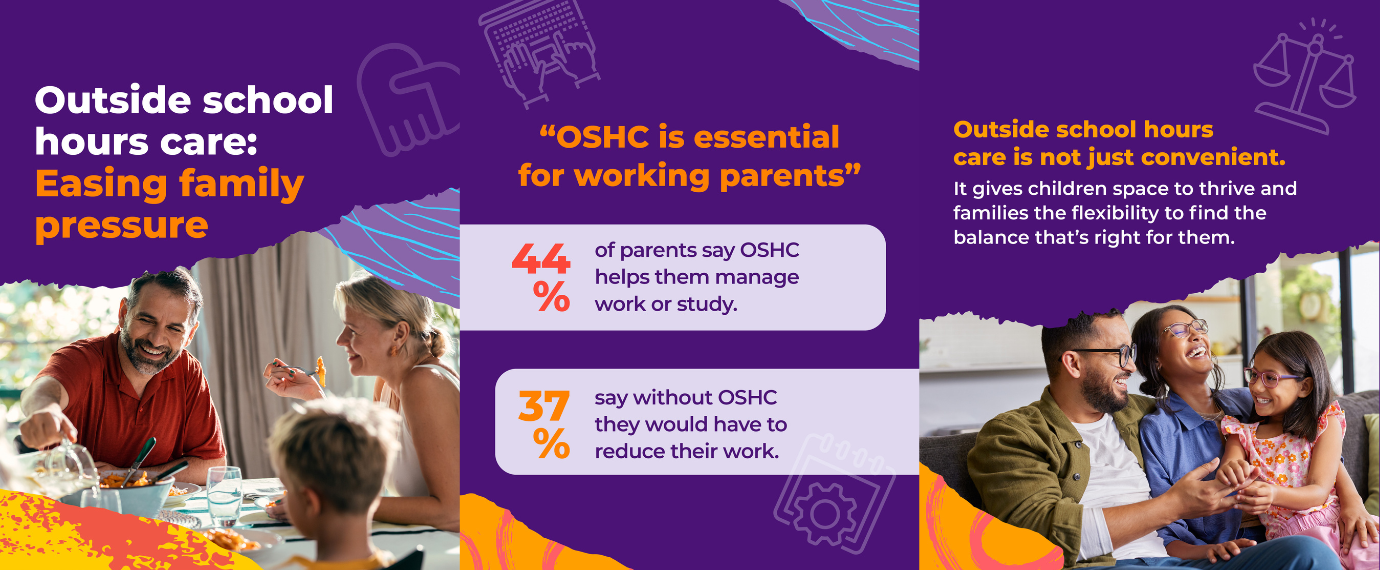 Alongside the data, the research summary captures a message that came through clearly:
“OSHC is essential for working parents who need a safe place for their children before or after school.”
For families, the value of quality care outside school hours is not only in “covering the gap”. It is in creating time and space for children to play, connect and feel supported in the hours beyond the classroom.
Holidays matter too
Families also told us that the need for support does not stop during the school term. School holidays can be a pressure point in a different way, as routines change, work continues for many households and children still need safe, engaging options that keep them connected and active.
When families spoke about what they want for children outside school hours, it applied across the school year, including holidays: activities that keep children moving, learning through play and spending time with friends.
A note on choice and what 'support' means
It is important to acknowledge that families define support differently. Some families want more flexibility in their week. Some want to be present for more moments, not squeeze in more work. Others are balancing competing responsibilities and are simply trying to make afternoons run smoothly.
Across these differences, the consistent theme in what families shared was this: children benefit when after‑school time and holiday time include real opportunities for connection, play and wellbeing.
Closing reflection
This is the final article in our "Beyond the School Day" insights series, sharing what families told us about life outside the classroom. What happens beyond the school day shapes how children feel, how families connect and how manageable the week becomes.
The strongest message from this research is not that families need to do more. It is that children deserve time outside school that supports what families value most: play, wellbeing and social connection, across both outside school hours and during school holidays.
About the research (Australia)
The Jag Insights summary reports findings from national research designed and conducted by 89 Degrees East, an accredited independent research consultancy. The Australia study was an online survey conducted in February 2025 with more than 1,500 parents or caregivers of children aged 5–12 years across Australia.
Related Articles
/f/166376/1380x868/c4d03feab7/juggling-work-and-school-holidays.png)
Beyond the school day: the truth about the after-school juggle
05/03/2026
-Junior Adventures Group
Research shows the after-school juggle is a major pressure point for families. This first insight in our 'Beyond the School Day' series shares what parents are navigating and the support they need.
/f/166376/1380x868/9ca21c8a15/why-play-is-the-brain-s-best-preparation-for-school.png)
Big school, big insights: Why play is the brain’s best preparation for school
17/12/2025
-Junior Adventures Group
Discover how play supports brain development and school readiness. Learn why play-based learning helps children transition confidently into school and OSHC.